


Note to Readers: I published a similar opinion blog to this one a couple of years ago. Today, I have updated it, including new thoughts and opinions. Because the basic premise of my points is the same, I have included, after this essay, the comments left on the original post. I invite those individuals and you to please contribute to the dialogue.

The Baseball Hall of Fame is set to honor three Class of 2025 inductees — Ichiro Suzuki, CC Sabathia , and Billy Wagner each received enough votes from the Baseball Writers’ Association of America (BBWAA) to punch their tickets into Cooperstown. They are joined in the Class of 2025 by Dick Allen and Dave Parker, who were posthumously elected via the Classic Baseball Era Committee. Thomas Boswell and Tom Hamilton also will be honored with the BBWAA Career Excellence Award and the Ford C. Frick Award, respectively, during Hall of Fame Weekend. These honorees will be officially introduced during a ceremony on Sunday, July 27.
Suzuki, Sabathia, and Wagner have been deemed worthy of enshrinement by the 394 members of the BBWAA for their statistics, longevity, and periods of domination as being judged amongst the very best of their era (overall and at their position), post-season contributions … and, according to election rules, their “integrity, sportsmanship, character, and contributions to the team(s) on which the player played.” This last element of assessing the worthiness of admission to the Hall is referred to as “The Morals Clause.”
This begs the question, is baseball’s most esteemed institution a Hall of Fame or a Hall of Morality?
This is a particularly thorny debate for baseball purists, significantly ramped up in intensity when assessing those who competed in what was deemed the “steroid era” in MLB. Unquestioned giants of the game, in any era of comparison, have been shut out of the Hall because a majority of voting writers have hypothesized that these players used performance-enhancing drugs (PEDs) to elevate their performance. Most notably, not making the grade for enshrinement are Barry Bonds, Roger Clemens, Sammy Sosa and Mark McGwire.
Each of these individuals should have a plaque in the HOF. My logic follows.
Intoxicating Data, Ducats and Delirium

Let’s take a deeper dive.
Were these four ballplayers superstars? By any definition of the word, unquestionably yes.
Statistics? Inarguably, amongst the best cumulative and single-seasons in baseball history and, in some cases, THE BEST in the game’s annals.
By their singular presence on the field, each of these ballplayers shined a considerably brighter spotlight on the game. This conclusion was embraced by the Lords of Baseball, fans of the game, and even those who didn’t closely follow the sport. Uniquely, they each directly contributed to driving considerably more:
- Fans and non-fans to the ballparks, theirs and on the road.
- Viewers to their televisions and listeners to radio broadcasts.
- Advertisers and their mega-dollars to ballparks and broadcasts.
- Sales of baseball jerseys, paraphernalia and accouterments.
- A massive infusion of revenue directly into the pockets of the owners.
- Hometown pride for their respective team’s community.
- And, ironically, readers to baseball writers’ columns.
I believe that the 394 members of the BBWAA who cast ballots in the 2025 Hall of Fame election should have singularly evaluated players’ statistics and contributions to the game. What was their worth to the National Pastime during their respective eras? During their careers? How did they stack up on the field compared to benchmarks set by the acknowledged greatest to play the game? Did they have “HOF careers”?
The Neverland of Speculation
Crossing into the Neverland of speculation introduces too many slippery slopes. I do not deny that there was a steroids era in baseball. To do so would be foolish. My point is that sneaking suspicions supported by hunches, observations, and even fair investigative reporting don’t go far enough to cull the guilty from the group as a whole decisively. Casting aside the issue of burden of proof — which is in and of itself an alarming concept — BBWAA members do not have the capacity, let alone the moral authority, to conclusively draw a line in the sand and dictate, “Okay, you’re over there. You … you’re over here on this side.” Piazza, Bagwell — over here. Bonds, Clemens — over there.
To me, that has too much potential to cheat the history of the game.
Does one generally know when someone is of high moral makeup, possessing the intangibles of “integrity, sportsmanship and character”? I would answer yes. You can see it. You can admire it. However, you can’t grade it with 100% certainty because we all have predispositions and biases.
What you can measure, evaluate, and even critique with focused, analytical rigor across this great game’s history is on-field performance.
The majority of writers with ballots have clearly made a collective decision to blackball these mega-stars of our national game. What other word more accurately describes what has occurred? Were this a court of law, this subjective stamp of guilty — by appearance and not proof — would never hold up.
The Choir Boys HOF

Does anyone have a moral compass that doesn’t waver? Methinks not. Were the Baseball Hall of Fame to admit only those associated with the game who showed a consistent and uncompromising adherence to strong moral and ethical principles and values, the number of plaques in the building could fit in a very, very small hall(way).
Unquestionably, some men stood tall not only on the field but in life. Jackie Robinson jumps to the front of the line, at least in my mind, in courage, outstanding achievements, and noble qualities. Roberto Clemente is also on this list.
Others also put up exceptional numbers and have a reputation for being good eggs. Cal Ripken Jr., Tony Gwynn, Willie Stargell, and Brooks Robinson come to mind.
But Cooperstown is hardly the hall of charming, affable, good or even in some cases likable men. It’s, as it should be, a club of men who were great at baseball.
The HOF is strewn with individuals — players, managers, owners, commissioners — with socially unacceptable flaws. To be fair, I insert the word purportedly on this list of portrayals of HOFers:
- Ty Cobb (violent and sociopathic racist)
- Babe Ruth (womanizer and heavy drinker)
- Grover Cleveland Alexander (alcoholic)
- Mickey Mantle (alcoholic and philanderer)
- Cap Anson (instrumental in forging baseball’s color line)
- Kenesaw Mountain Landis, MLB’s first commissioner (made sure baseball’s color line would not be crossed)
- Tris Speaker (a member of the Ku Klux Klan)
- Tom Yawkey (owner with clear resistance to signing black players)
- Gaylord Perry (one of many players who walked the line of duplicitous behavior on the field to gain an advantage)
- Commissioner Bud Selig (turned a blind eye to rampant amphetamine use and the PED era)
Dark blemishes all. The contemptible behavior of some of these men categorically deserves society’s scorn and moral indignation. The measure of these individuals’ character is a stain that will forever be associated with them, their actions debated and discussed by future generations.
In 2008, former baseball players’ union chief Marvin Miller, himself finally elected to the HOF in 2020, noted, “I think that by and large, the players, and certainly the ones I knew, are good people. But the Hall is full of villains.”
History, in general, paints a detailed picture of how society worked and what individuals’ makeup was “back in the day.” History is who we are. Baseball’s history is captured in the museum that is the sport’s Hall of Fame. All of its history.
Moral qualities recognized, if you accept my standard for admission — sterling on-field accomplishments — they all belong in the HOF. Regardless of how you assess these men and their actions and inactions, these ballplayers were Hall of Famers on the field.
Charlie Hustle and Shoeless Joe

Photo credit Wikipedia.
I would be remiss if I didn’t address in this piece the lifelong ban of Pete Rose for betting on his own team’s games, and of the eight members of the 1919 White Sox after they threw the World Series. Confession: Rose, the game’s all-time hits leader, was my baseball hero when I was growing up. I admired his fire, his love of the game, his consistency. By all accounts, the children in the Gilded Age felt the same about “Shoeless” Joe Jackson, one of the players banned for his “part” in the Black Sox Scandal, as I did about Rose — near idol worship of a truly great ballplayer.
Rose, who passed away September 30, 2024, and Jackson (1887-1951) have recently been reinstated by MLB and are now eligible for the Baseball Hall of Fame. This decision by Commissioner Rob Manfred, made after decades of these two players being on the permanently ineligible list due to gambling on baseball games, allows them to be considered by the Classic Baseball Era Committee. The earliest either could be inducted is 2028.
Rose’s and Jackson’s actions crossed MLB’s most sacred baseline for behavior. Theirs were transgressions of the highest order and went to the fabric of the game. Both players — indeed, pariahs — did the crime and paid the price.

1913. Photo credit Wikipedia.
Still and all, I believe that both of these individuals should have plaques in the Hall of Fame. Rose and Jackson were inarguably historic figures on the field. Ergo, they were spotlight players in the history of the game.
It’s not the Hall of Shame. It’s also clearly not a shrine to honor character. They are amongst the game’s greatest players, and their on-field achievements should be acknowledged. Because baseball’s #1 rule concerns betting on the game, Rose’s and Jackson’s plaques (segregated within their own room?) should note their offenses and the fact that their actions dishonored the game and that the stiffest of all possible penalties were dispensed. Let the Hall contribute tangibly to educating its visitors about these wrongdoings.
PED “Users”
But what of the alleged PED offenders who rose to the very top of the game with scintillating, year-after-year, hold-your-breath on-field accomplishments? Those who kept us glued to our seats, and brought unquestioned thrills and great value to the game as played in that era as a whole?
Were Bonds and Clemons, for just two examples, putting up HOF numbers before suspicion of PED use surfaced in the game? If no one was definitively caught and proven to be using steroids, are they genuinely guilty of staining the game? What percentage of juiced hitters were facing juiced pitchers? Were Bonds, Clemons, and the others under suspicion competing against rosters full of fellow users? How much did the rampant use of amphetamines, commonly used for decades, ratchet up game performance in the prior era? Like most substances in question in this debate, greenies weren’t even against baseball rules for long periods when they were allegedly used to speed recovery time from physical exertion and get “up” for the game. We’ll never know the answer to these questions.
How do you gauge the ungaugable?

You don’t. Instead, when assessing the greatest, you compare performance. You juxtapose the most outstanding players’ numbers against their on-field competition, as well as era versus era. Stats don’t lie. They don’t need a judge and jury assessing “evidence” and character.
So give them a pass? Hardly. Let generations — fans and non-fans — fuel the debate. That is how the past teaches future generations. History has always included the missteps, indiscretions, and lapses in judgment of any particular generation’s celebrated individuals. Great men and women who have made significant contributions have also made tremendous and sometimes grave mistakes. In baseball, as in life, let history paint the full picture of these athletes and men. It will not always be flattering. But it will always be worthy of a good, sometimes raucous, debate.
The statistically deserving of our most outstanding ballplayers should be enshrined in the HOF. Once they are, they will have their morality or lack thereof, scrutinized as any public figure who sets a bad example is remembered.
Legends aren’t saints. The purpose of Cooperstown is to house the history of the game, good and tainted. It’s inconceivable that the game’s hit king, its grandest home run hitter, a seven-time Cy Young winner, and a player some called the greatest natural hitter in baseball history, would not be worthy of admittance to the museum of the history of the game.
Their HOF Plaques
When I visited Cooperstown and the Baseball Hall of Fame, I was awestruck. Indeed, the kid in the candy shop. I wish I could have spent a week in this magnificent repository of the game’s history and shrine to its greatest players. I have zero doubts that when I return, I’ll get the same goosebumps.
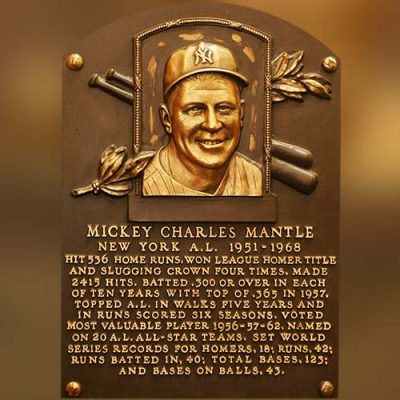
I think back on standing in front of and reading Mickey Mantle’s HOF plaque. I only saw him play in person a few times when I was growing up, and those were the twilight years of his career. As I read his plaque, my mind leaped back to newsreels of this magnificent specimen of a ballplayer. Of his prodigious home runs from both sides of the plate. His speed. His enthusiasm for the game. His camaraderie with his Yankee teammates. His patrolling of center field. His World Series records.
I pored over his HOF plaque, but didn’t have to do so. Embedded in my mind were his three MVP awards and his 20 All-Star games. His Triple Crown year in 1956. His four home run titles. His shared quest with the great Roger Maris in 1961 for the single-season home run record.
I also knew many particulars about Mantle that were not articulated on his plaque. That he was never quite 100 percent for so many years. That his dad named him after future HOF catcher Mickey Cochrane, and taught him the game. That the statistics guy in me was sad when his last year’s performance dropped his lifetime batting average below .300 (to .298). That he was the heir apparent to Joe DiMaggio, whose last season was Mickey’s first … as a 19-year-old Adonis.
As I think back on that moment, I recognize now that The Mick’s HOF plaque was simply an extension of all of those baseball cards that I collected and studied as if my semester’s grade depended on it. Those Topps cards were de facto mini-plaques, presenting the facts that were his stats along with, on occasion, tidbits of the Commerce Comet’s life. I didn’t know it at the time when eagerly consuming the backs of those cards, but I know now that I was reading early versions of my hero’s HOF plaque.
Guess what was not on Mantle’s HOF plaque? There was no word about his self-destructive behavior — his hard-drinking lifestyle that eventually caught up with him and took him from us at the age of 63. There was nothing about my hero often failing to keep himself in game-shape above and beyond the many legitimate injuries he suffered. Nothing about his after-hours activities; his carousing as, clearly, a high-functioning alcoholic.
It appears that those real-life characteristics and self-decisions were not what the baseball writers at the time included in their assessments of Mantle. They made him a first-ballot HOFer. Rightfully so.
The back of a player’s baseball card should be the sole admission ticket to stand with the game’s greatest players, all of whom were flawed in one manner or another. Call’em as you saw them. On the field.
Landon "Alfie" Cross
Lee, hopefully I don’t go down that rabbit hole too far with my reply from Right Field …
I am not as keen follower of baseball as Lee and other bloggers here, but I have very fond memories of playing in the Little League in the 1950’s in Bristol, Virginia … for those of you who don’t know the town it is on the state lines of Virginia and Tennessee … has a state street and back then we could play on either side of the town, which was great for my brother and me, because the best teams were on the Tennessee side … my last year in Western LL we went to some state playoffs after winning double digit games … so this is kind of based on the my experience as a young player …
“So here I am in right field tonight, yeh, I know less important than center or right field, but I have a good arm for throwing and can catch everything that comes my way … that’s not correct … I have a GREAT arm … normally I’m the pitcher in the rotation, because I pitched a few days ago … and the kid who normally here in RF is sick tonight … so I can throw to second, third or even home plate with only once bounce … although not a pitcher, my favorite player to watch on TV is with the New York Yankees, number 7, Mickey Mantle … just amazing how he hits and even fields the ball, I want to be like him when I grow up … ”
I understand that the questions being asked for Who-is and Who-is-not, would not be decided by 10 to 12 year olds, but if I could go back in time and ask myself should they be allowed to join … I believe I would say … Yes … For Love of the Game …
Bob Brown
Excellent article as always, but I’m about to say something that I think I’ve never said. I disagree with Lee Cooke. I disagree with the underlying premise.
I am not a writer, so my thoughts will ramble and not be eloquently presented, but I hope you can bear with me even though I disagree on some points.
The National Baseball Hall of Fame and Museum is a history museum as well as a Hall of Fame. The Hall’s motto is “Preserving History, Honoring Excellence, Connecting Generations”. I think one problem is that fans tend to truncate the name at Hall of Fame.
I don’t think it’s a matter of Hall of Fame vs. Hall of Morality. While I agree that some players and other inductees in the Hall of Fame had “socially unacceptable flaws” as you say, being a racist, womanizer, alcoholic and so on, those morally reprehensible character flaws did not enhance their game performance or contribution to the game. Well, I will say that racism obviously disallowed talented players from playing, and that affected the quality of the pool of players.
I can’t say that Babe Ruth’s womanizing and drinking, or Ty Cobb’s racism, and so on, improved their playing abilities and the numbers on the back of their cards. Gaylord Perry, on the other hand, admitted to throwing a spitter and wrote a book about it.
For Ruth, Cobb, et al, I agree it’s the Hall of Fame and not the Hall of Morality, and for my reasons stated above, I agree they belong among the immortals. But I draw the line at cheating. If, and I know it’s an if, Bonds and the rest used PEDs, then the numbers on the backs of their cards are questionable. Are they really one of the GOATs?
I want to digress for a moment and mention that the building in Cooperstown is the National Baseball Hall of Fame and Museum. You mention the museum and you said, “Baseball’s history is captured in the museum that is the sport’s Hall of Fame.” I may be splitting hairs, but the museum does capture baseball’s history, but the portion that is the Hall of Fame with the plaques is a special space. That is, the museum is not the Hall. The Sosa-McGwire battle is in the museum. That doesn’t mean all the players involved deserve a bronze plaque.
You mention the issue of burden of proof by the BBWAA. I wonder if you are using burden of proof in a similar way as beyond a shadow of a doubt, which is the standard in a criminal court. I think the BBWAA only need to consider a preponderance of evidence, which is the standard in civil cases.
You also say “BBWAA members do not have the capacity, let alone the moral authority, to conclusively draw a line in the sand” and I don’t argue what capacity their members may have, or if they have “moral” authority, but they definitely have authority granted by the National Baseball Hall of Fame and Museum to decide who is in and who is not. Should they? That’s another topic for debate, but the Hall is a private entity and they make the rules. You also proposed somewhere about looking at stats, and I will address that below.
I draw the line at cheating and illegal performance enhancements. If their accomplishments on the field, those statistics on the back of their cards, are the only criteria regardless of how they were achieved, then we don’t need voting. Simply establish a baseline of statistics that grants enshrinement. At one time, it was loosely 3,000 hits or 500 home runs, or 300 wins. There is the line in the sand. Flip their card over. 500 HRs. You’re in. Only 499. Sorry, but you missed the cut. Sorry, Lou Gehrig had “only” 493 dingers and “only” 2,721 hits. My favorite player, Brooks Robinson misses, too.
And those numbers are primarily offensive, which ignores the defensive contributions. If you just read about Brooks Robinson’s fielding percentage, especially in the 1970 World Series, rather than seeing the plays he made, you may not think that he was worthy of the Hall. Brooks had some amazing career defensive stats, but chicks dig the long ball.
The point that I fail to state well is that the process is partly subjective based on the totality of the player’s accomplishments on the field, and perhaps, how those stats were achieved.
I also don’t deny the steroid era occurred, and I’m not convinced that it or something like it doesn’t still go on. I agree that Bud Selig is culpable, as well as managers, coaches, and front office personnel who knew. They didn’t care about steroid use as much as they cared about the almighty dollars that were rolling in when fans paid to see if Sosa and McGwire would both hit one out today.
I agree with your description that Mickey Mantle was a “magnificent specimen of a ballplayer,” which is something I will not say about Barry Bonds.
Somewhere, you mention “The purpose of Cooperstown is to house the history of the game, good and tainted,” and you add that you disagree that they “would not be worthy of admittance to the museum of the history of the game.” While I agree (splitting some hairs again, but this is one of my primary points of contention) the purpose is to house the history and they should be part of the history, I think they are part of the history. In the museum. But that doesn’t grant them admission to the Hall.
The museum does have the history, “good and tainted,” to use your words. The Hall is where we see those “magnificent specimens” enshrined. The museum and Hall are not synonymous.
Jackson and Rose? Yes, I say they should be in the Hall. Why is gambling baseball’s so-called #1 rule? Because the 1919 World Series gave owners a reason to be concerned about the “integrity of the game,” which really means their money. The owners created the Baseball Commissioner to restore public confidence that the games weren’t fixed. What did Shoeless Joe Jackson do to throw the Series? He batted .375, had 12 hits (a record at the time), .563 slugging, and so on. Jackson and his teammates were acquitted in a court of law, but baseball needed to make an example and draw their line in the sand. Rose bet for his team to win; not lose. Here we are more than 100 years after the 1919 Series, and baseball still struggles with betting as the primary infraction while coddling drugs.
And I don’t care what the sign says in every clubhouse, when MLB got in bed with the sports betting entities, they lost all credibility that MLB thinks betting is an unforgivable violation. Why did MLB embrace betting as sponsors? The same reason baseball has made every decision. It’s not integrity. It’s money.
Sam Dannaway
The HOF voters seem to have no problem allowing alcoholics and racists to enter the Hall.
Shoeless Joe and Pete Rose should be in the Hall.
Also, players like Ron Santo.
Reed Sprague
Thank you, Lee, for another well-written, thought-provoking and interesting blog post. I really appreciate your writing. You are fair and objective. Few writers are.
Here’s my problem with MLB HOF PED and so on: I do not blame the juiced players at all, and I realize that the vast majority of people (probably ninety-eight percent) who have an opinion about this problem do blame them. I place all of the blame on the managers, coaches, owners, team executives and, especially, the commissioner, who served just prior to and during the PED era. I realize I am one of the ten in this waaaay outside corner of the room, so I put out there with the risk that all the world hits I will reap and let into me (probably a tad too much drama, but man, that did feel good). It’s easy to blame young, over-confident – even arrogant – over-paid players. I get it. Who among us has not secretly wished for A-Rod to “get the karma he deserves” for making so much money for doing so little for society and for acting deserving, or even cocky, while doing it? And what about Bonds, the guy who insisted on being treated like royalty (literally) just because he was capable of hammering a baseball with a bat like few others could hammer a baseball with a bat? And just who does The Rocket think he is, taking PEDs just so he could continue to throw a fastball 95 mph well into his late thirties, and even into his early forties, while arrogantly throwing a broken bat at a well-loved catcher? And, is it not human nature to want Mark McGwire to be knocked down several hundred pegs for his display of arrogance when he worked out with two-hundred-pound dumbbells for all the world to see — publicly displaying his bloated (and artificially made) muscles? These players, and others similar to them, are our scapegoats. What a bunch of rogues! So, get the whips and let’s get to whipping, and whatever you do, do not bring up our sacred Hall of Fame for these miscreants!
Or maybe not …
Just as we have a group of imperfect human beings involved in this mess — the players — who are easy to identify as deserving of our wrath for the staggering and inexcusable baseball PED nightmare, if we look closer, we quickly find that we also have some old guys who are much sneakier than the young bucks. And sneaky is what brought us the PED era in baseball.
So, let’s look closer at sneaky …
Is it sneaky to change the rules of baseball without writing the changes into the rule book? Yes, it is. Is it wrong if the players play by the new rules even though the bosses do not write the new rules into the rule book? No, it is not wrong. Baseball players, as well as practitioners from all professions, conduct themselves by many unwritten rules, and that practice will continue (although it really should not continue in any professional sport). Was it sneaky when managers, coaches, owners, executives and, yes, the commissioner, all said they “didn’t know” about PEDs in baseball when there is zero chance that they didn’t know? Those players who eventually told us about “the secret” through their books, interviews and articles, told us that for nearly a decade (some say longer), the PEDs were piled on the tables in every clubhouse in every MBL stadium for players to take as desired. A decade! In all clubhouses! Was it some miracle that the bosses did not see the PEDs sitting openly on the clubhouse tables? Is that really possible? No, it is not. The total of all the bosses combined — say, around 5,000 people or so over a ten-year span — did not know? For ten years? Seriously?! So, let’s not be silly and say the bosses “didn’t know.” Of course, they knew.
If we were challenged the same way …
If any of us mortals were offered (either directly or indirectly) millions of dollars by our bosses to take PEDs for a few years in order to make our profession “more exciting” (although I personally do not believe power makes the game of baseball more exciting) and at the same time extend our career by another very productive four to eight years, probably ninety percent of us would take PEDs. It’s human nature, and human nature always wins out. Would we be wrong to partake? No, we would not (unless the behavior were illegal). Would we be cheaters if we partook? No, we would not. We would simply be following the rules set forth by our bosses, even though our bosses didn’t write down the new rules and even though our bosses told all who asked that they “didn’t know” what we were up to.
Hall of Fame or of Hall of Shame …
Baseball writers should formally place blame for PEDs squarely where it belongs, with the BBB (baseball’s big bosses). Players should be voted into the BBHOF based on their level of play during all eras of play. Sammy Sosa played elite baseball during the steroid era and throughout his career. As did Barry Bonds. And A-Rod. Mark McGwire, and the others on such a list. You know who they are. In my opinion, all of them should be in the Hall of Fame. No asterisk.
Scapegoating helps no one, hurts many, and, worst of all, it always lets the guilty off the hook. We humans are simple-minded. We will place blame on the group that the “experts” point to, and write endless narratives about, while ignoring all other groups. The narrative takes over. Reason and objective analyses are nowhere to be found. The elephant in the room is ignored. But this ain’t smart to do. Because, sometimes the experts are sneaky. Sometimes they not only point away from the elephant, they also tell you that there is no elephant to ignore. Additionally: “The best defense is a good offense.” A better way of putting it might be: “The best defense is a good first offense.” Whatever you do, start the narrative. Then control it. “I didn’t know” again and again is a great way to gently steer the narrative. Don’t wait for someone else to gain that insurmountable advantage!
Baseball writers have the opportunity to do a much greater good for us all by refusing to honor the inexcusable actions of the baseball bosses with regard to PEDs. They can and should send a clear message: Do not scapegoat even an unpopular group of imperfect human beings in order to deflect blame from yourselves. We all should place blame on the guilty (PED-Era baseball bosses placed into the Hall of Shame, maybe?) and honor on the achievers (PED-Era elite players placed into the Hall of Fame). It really can, and should, be that simple, except that we can’t do it if we’re fooled by the sneaky people.
Debbie Cooke
David, I happen to know that your children don’t have to “go somewhere” to see one of the best examples of morality I know…they live with him every day. Keep living your life, Sweetie…and they will grow up knowing exactly who to look up to. oxoxox
David Wolf
Someone very wise once wrote, “Character Counts, First, Last, and Always”. I couldn’t agree more. While there are plenty in the Hall who I do not think are worthy, we shouldn’t lower our future measure stick because of it. If it makes the Hall smaller and more elite, what would be wrong with that?
I’d support an actual Hall of Morality, where we could celebrate those who lived up to high character ideals and contributed to society. That’s a place I’d love take my kids and show them people to look up to.
Reed Sprague
What he said.
Gary “Count” McCorkle
Jake, from our high school Echo days, we knew Lee was a talented writer. He’s only gotten better now!! I’ve never known Lee to be controversial; he’s a peacemaker at heart. He’s always been one to politely cause us to look introspectively at tough issues. So many more could benefit from his style and approach. It’s sickening and heartbreaking to read so many vitriolic comments on social media platforms today. Be it politics, racial issues, etc., people spew such hatred. It’s the Lee Cooke’s of the world who can lead us to a point of mutual respect and even admiration!!
Jake
WOW!! I like that. Like Gary, I’m going to have to read that again before responding.
P.S. Did Lee know this piece would bring such responses?!?
LSomerbyCooke
Thanks for your excellent, thought-provoking comment, Gary. For us lifetime baseball devotees, this is a confounding subject, indeed. It took me a looonnnggg time to take a stand — i.e., history is all-encompassing, not pick and choose, especially in gray areas. You have offered elegant, intriguing ways to confront this particular dilemma, and I appreciate your thoughts. You should know that when I came up with my Mantle-focused conclusion, I thought, “Gary will like that.” 😊 Again, thanks, my friend.
Gary "Count" McCorkle
Lee, I have taken this long to respond because I had to sort out my thoughts on this one. Maybe by the conclusion of my reply I’ll have a definitive position. Let me say first that most friends know me as a basketball man but baseball was the sport of my youth and remains my favorite. Yes, baseball — the sport where catchers “framing” of over 90% of pitches per game (an attempt to cheat), the base “phantom” touching (cheating) of second base on an infield double play is accepted but a player must always touch home, first base, or third base, and the sport where an umpire usually expands his strike zone on 3-0 pitches (cheating) to avoid walks because even though the pitch was a ball, it was “too close to take.” The old hand grenades and horseshoes philosophies. My beloved baseball has always struggled with a sense of morality, inconsistent with what’s acceptable and unacceptable, permissible and not, encouraged and not. I guess I’m a purist who desires the black and white versus the gray, or dare I say, balls and strikes?
I went to Merriam Webster and saw this:
Definition of Hall of Fame
1 : a structure housing memorials to famous or illustrious individuals usually chosen by a group of electors
2 : a group of individuals in a particular category (such as a sport) who have been selected as particularly illustrious
Definition of fame (Entry 1 of 2)
1a : public estimation : REPUTATION
1b : popular acclaim : RENOWN
Definition of renown (Entry 1 of 2)
1 : a state of being widely acclaimed and highly honored : FAME
Without my 2 cents on the controversy with the electors (no, I’m not related to Dick Allen or Gary Sheffield who never met a sportswriter they met), to me all of the players mentioned in your post and in the comments of posters deserve HOF status or at least serious consideration. I think a concern might be is “fame” the only criteria to be included in the HOF or does “morality” need to be factored in more as you aptly addressed? Perhaps if criteria is clearly stated before players start a MLB career, that would help. 10-12 year career minimum; if a batter, .300 avg, 500 HRs, 400 stolen bases, 150 outfield assists, etc. would be automatics. As a pitcher, 250 wins, 3,000 Ks, 700 winning %age, 450 saves, .630 winning %age, etc. Criteria like the record industry uses – 500k sales = Gold certification; 1M = Platinum; 2M = Multiplatinum; 10M+ = Diamond. Takes all the subjectivity out of the equation. 499K sales? Sorry, that’s not Gold! Wanna add morals clauses? No felonies, 3 or less DUI/DWI convictions, 0 rapes/sexual assault convictions, 0 child pornography convictions, 0 drug charges, etc. Struggling with convictions versus allegations, make criteria for allegations too (OJ, Cosby, etc.) [Side point: Who was the late Steve Howe ABLE to earn 7, count ’em 7, MLB suspensions for drug-policy violations???]. The HOF should make a clear decision on the type of Hall it wants to be. As much as I did not like Pete Rose (the way his Big Red Machine demolished my Yankees), I’ve NEVER seen a player play as hard as the former Rose career-ender did. A switch-hitter at that (partial for obvious reasons)! 😊 Our buddy and former classmate Sam Dannaway raised a great point about the salvation of baseball during the Sosa-McGwire seasons. Clemens, Bonds, A. Rod, Palmeiro, Pettitte – I watched play, some in person, and they each were as great ballplayers. But how much of their greatness was legit, from a level playing field?
Bear with me as I share my points of consternation. First, as a parent if I set boundaries or limitations or expectations for my children and if they willingly violate them, do I administer consequences? Yes I do; some of the consequences they know ahead of time, others I surprise them, usually based on any repeat “violations” or exceptionally egregious ones. When I was a principal, I often told my students, “For every action you do, there is a reward or a consequence.” I still believe that.
Secondly, as a Christian I immediately thought of 2 biblical characters as I read your wonderful article; Moses and David. Both were great men of God who achieved much “fame.” As humans, as well as me, we mess up as we do. Both suffered major wonderful and visible failures. David was a stalker and an adulterer, got a married woman pregnant, made arrangements for her husband to come home from war to sleep with his wife so everyone would think the husband impregnated his wife whom David slept with. When the husband refused to sleep with his own wife because he felt he shouldn’t enjoy the sexual pleasures of his wife when his fellow soldiers were denied similar pleasures on the battlefield since they were on the battlefield and not in the bedroom. David had him and hit killed on purpose. Too that Clemens and Bonds! Moses did great things but the Israelites got of captivity yet he also murdered a man and hid his body in the desert and while leading the people in the wilderness he disobeyed God and God told him he’d not go into the Promised Land. So while Moses got much notoriety and wrote, that Sosa and A. Rod! Their consequences — David would never see the child he fathered with Bathsheba (“blood hands”) yet his son was. Moses not allowed to enter the promised land; his AAA understudy replacement was Joshua. Both had great fame and notoriety, their disqualifying consequences, but rights – BOTH Moses and David are mentioned prominently in the Book of Hebrews. Granted after “season-ending” infractions. Athletes often enter after “disqualifying behaviors,” they made it in!
So my conclusion is this: if the Baseball Writer’s Association of America doesn’t want to let morally fit Hall of Fame eligible candidates requirements with some of my aforementioned disqualifiers in, after a generation from the players “stink” that led to the players’ exclusion, playing obscene stats and career clearly warrant inclusion by the very definition (above) of “fame” should be let in. Mr. Rose, Mr. Bonds, Mr. et al.
Lee, I apologize for the length of my reply but now you know of my struggle to come to a conclusion. But then again, my verbosity and long-windedness is YOUR fault; you were my sports idol when we both wrote for our high school newspaper!
Tim Thomas
A fascinating and insightful perspective. As usual, thoroughly entertaining and educational.
Ric Joyner
As usual, it was jammed pack with such interesting reading, I had to go back twice to finish it. It was great. I don’t have the intellectual background skills like you but I can say as usual it was a good read and a great writing epitaph of your skills.
Jake
I do admit you are correct that Bonds would have made the Hall without PEDs. He was a great hitter and did a fine job at the family business. So then why? I can think of a lot of reasons, some good some bad, but he didn’t use steroids to heal; he used them to compete at a higher level than he was able. Asterisk, HOF career till 99? Your thoughts?
LSomerbyCooke
Thanks, Jake. I don’t often comment on comments, but I wanted to answer your direct question about Bonds. In short, yes, I believe he would have easily hit 500 HRs and, I believe, also crack the 600 level. He averaged 32 HRs from 1986–99, putting him at 445 before suspicion of PEDs. He played another seven years for SF. Even if he averaged 25 HRs during those years, he would have ended with around 620 HRs for his career. To me, a clear HOFer. Again, thanks for your opinion and for taking a read of my stuff! Much appreciated!
Jake
I think you left out the Hall of the Asterisk. There are quite a few players you mentioned that would not have gotten near the Hall if it were not for steroids, such as Bonds, Clements, Sosa and McGuire. They all might have had great careers, but do you really think Barry Bonds would have hit 500 homers? I understand that there were some bad people who did great things for baseball, but they didn’t cheat. So my opinion is that anyone found guilty of using PEDs should have an asterisk explaining how they got in. LOVE THE BLOG!!
Sam Dannaway
We all loved the summer of 1998 (including the owners, sports media and other parasites) when McGwire and Sosa singlehandedly saved baseball from its imminent demise. And now they spit on them. I was at Wrigley when the Cards came to town. McGwire hit one out, Sosa answered, and then McGwire hit another. The crowd, including me, went nuts each time. Baseball can never repay them, it is they who should spit on the “honored” HOF voters. If it is a Hall of Morality it definitely is very selective when it is applied. Shoeless Joe and Pete Rose also deserve to be in.
John Besanko
I don’t disagree with much of this, but … I think what really hurts the players from the steroid era (like Bonds and Clemens) is that their physical appearance changed dramatically and yet they loudly and repeatedly denied the obvious (sometimes under oath). It’s hard for the voters to forget that.